Memory as Responsibility: Speech by Ambra Laurenzi on the 81st Anniversary of the Liberation of Ravensbrück
17.05.2026
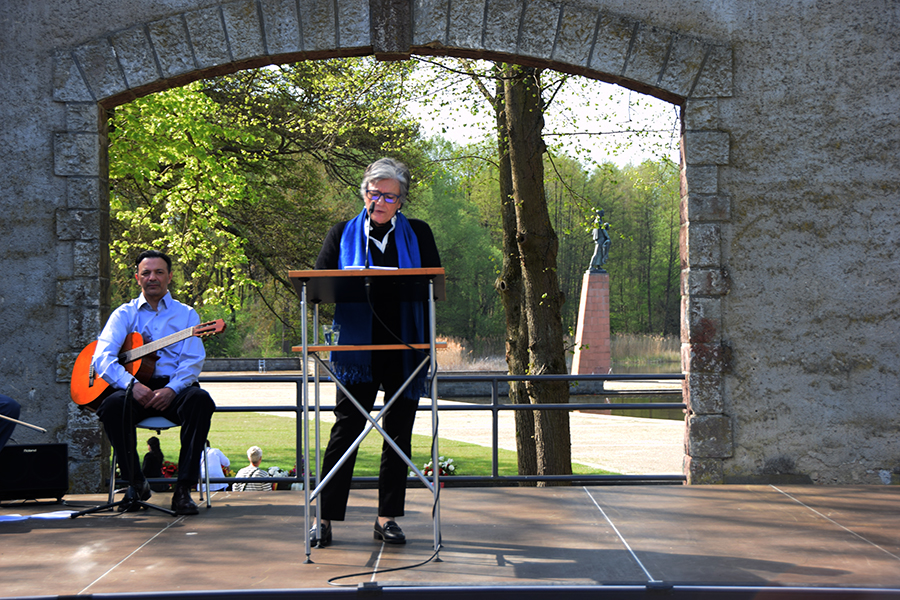
Memorial of Ravensbrück, 3 May 2026
Commemorations of the 81st Anniversary of the Liberation
I would like to thank the memorial site and its director Andrea Genest for organizing these commemorations, and I thank you all for being here.
This year we celebrate the 81st anniversary of the liberation of the Ravensbrück camp and, unfortunately, we must once again express a sense of dismay at what is currently happening in the world.
The disregard for international law and for the protection of human rights, not only by autocracies but also by governments that define themselves as democratic, is taking us further and further away from what the deported men and women entrusted us with in their vows and what they hoped for the future of new generations.
For many years we have hoped that the consequences of National Socialism and Fascism would serve as a strong antidote against the repetition of violence, invasions, and destruction, but unfortunately this has not been the case. Today, in view of what is happening, we try to find meaning in the suffering and sacrifice of our mothers and to understand how we can honor and pass on their terrible experience of deportation.
We have always understood the memory left to us as an opportunity for knowledge, as an instrument of exchange, and as political action. And when we use the term “political,” we do so in its noblest sense, as something belonging to the polis, to society as a whole, because the history of the camps does not belong to any single country; it belongs to humanity.
It is precisely from this conviction that last March the International Camp Committees, thanks to the support of the Dutch government, submitted to the ambassadors of the countries in which the main camps are located the request to include these sites in the UNESCO World Heritage List, of which only the Auschwitz camp is currently part.
We hope that this request will be accepted, even if we do not hide the difficulties.
But beyond the undeniable universal value of these places, being here today in Ravensbrück also represents a moment of individual reflection for each and every one of us.
This applies to those like me, daughters and granddaughters of deportees, as many of those present today, but also to those who are here because they are aware that the history that unfolded in this place concerns the conscience of each of us—individually.
I would like to recall here the words of Aldo Pavia, Vice-President of the National Association of Former Italian Deportees: “A camp is not visited; one encounters it in order to encounter oneself in silence.”
I would like us to make these words our own and realize that when we come to Ravensbrück, as to any other camp, we are not only undertaking a pilgrimage or a journey of remembrance, but we are confronting ourselves as individuals with what happened here.
Here we must find means of reflection, because as individuals we have responsibilities toward society and toward new generations.
Each of us is an integral part of the society in which we live, and each can and must fulfill their role, because as Primo Levi wrote in his book The Drowned and the Saved:
“We must simply know, or remember, that enormous crowds believed Hitler’s and Mussolini’s speeches. These speeches were applauded and admired, even though the ideas they conveyed were absurd, stupid, and cruel. Many people applauded them and followed them to their deaths.”
Today, unfortunately, we are witnessing in Europe and in the world an increase in wars and violations of human rights by states that are pushing the world to the edge of an abyss, without even respecting the rights of children, who represent the future of every society and whom we should protect. Today many children are denied a future. They are killed, deported, and physically and mentally wounded.
I want to believe that every heir of the history that unfolded in this place, and every person who has laid a flower here today, will commit themselves to creating a steel shield for them—just as our mothers did for us, and as the words carved into the stone on the lakeshore remind us.
A good commemorative ceremony to all.
Ambra Laurenzi, President IRK-CIR Ravensbrück, 3 May 2026